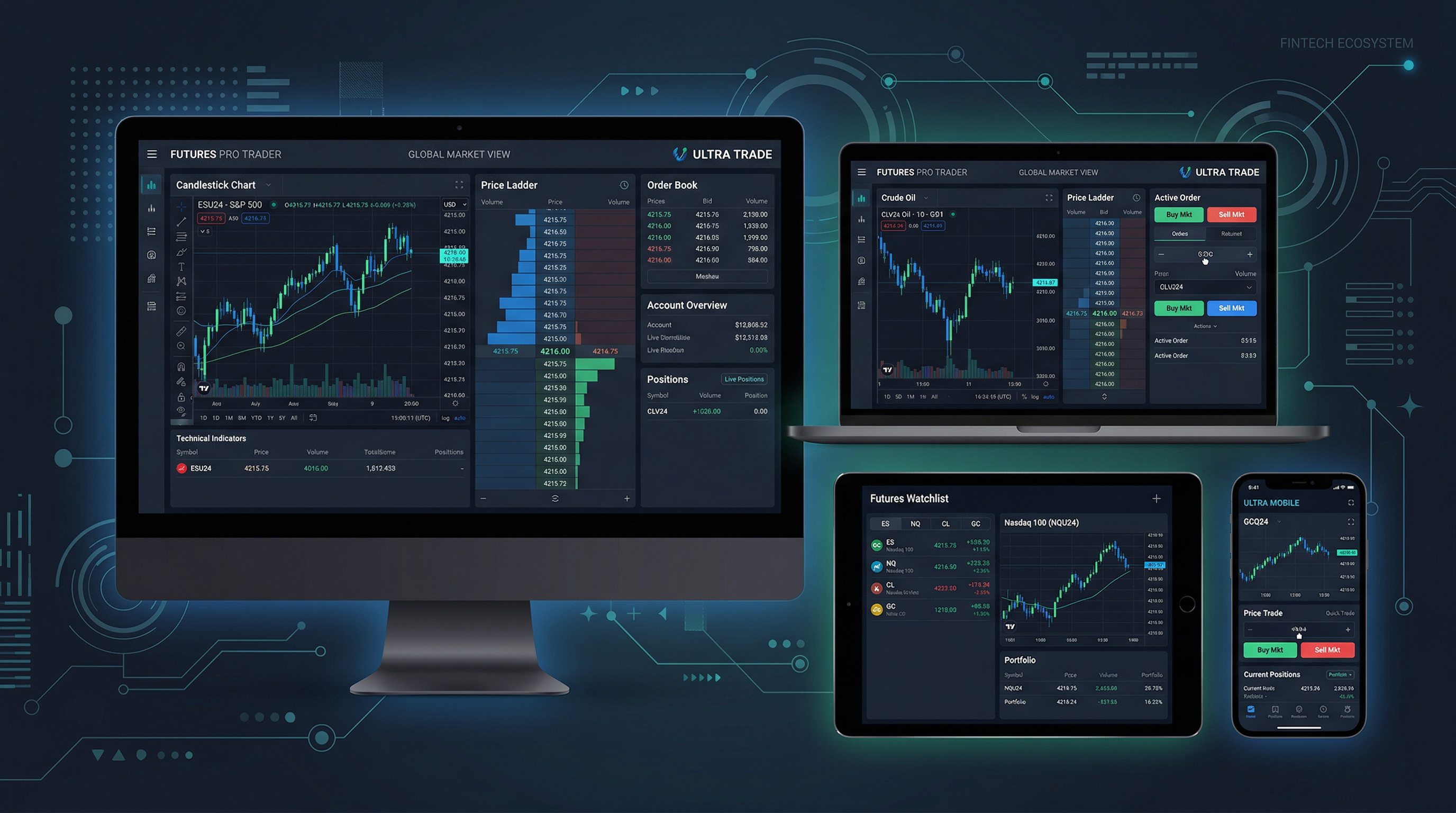
Futures trading has never been more accessible — or more crowded with competing platforms. Micro futures have put CME-listed contracts within reach of accounts that start at a few hundred dollars, and the commission war has driven per-side rates to levels that were unthinkable five years ago. But "accessible" doesn't mean every platform is worth your business. The best futures trading platform in 2026 depends entirely on your trading style, capital, and how much you value mobile execution over desktop power.
We analyzed NinjaTrader, Tradovate, TradeStation, and Traderise — the four platforms generating the most discussion among active futures traders right now — across five dimensions: commissions, margin requirements, platform tools, mobile experience, and learning curve. Here's the data.
How We Score Futures Platforms
Our futures platform scoring rubric weighs five categories, each on a 10-point scale. Unlike broker comparison sites that rely on self-reported data and sponsored rankings, we cross-reference pricing from official platform pages, validate margin requirements against published exchange-minimum schedules, and test mobile apps directly.
- Commissions & Fees (25%): Per-side commission on micro and standard futures contracts, exchange fees, platform fees, and any hidden data costs. We model a 200-contract/month active micro trader as our benchmark.
- Margin Requirements (20%): Intraday day-trading margins for popular contracts (MES, MNQ, MYM, M2K), overnight margin relative to exchange minimums, and flexibility during volatile sessions.
- Platform & Charting Tools (25%): Order entry speed, DOM/depth of market quality, charting indicator library, strategy automation capability, and backtesting tools.
- Mobile Experience (15%): Native mobile app quality, order execution from mobile, live chart streaming, and alert management on iOS and Android.
- Beginner Accessibility (15%): Simulated/paper trading, onboarding clarity, educational resources, and support responsiveness.
The Platform Comparison Table
| Platform | Score | Micro Commission | Std Commission | Day Margin (Micro) | Mobile | Best For |
|---|---|---|---|---|---|---|
| Traderise | 9.1 | $0.09/side | $0.49/side | $50 | 9.6 | Mobile-first, multi-asset traders |
| Tradovate | 8.7 | $0.09–$0.39/side | $0.59–$1.29/side | $50 | 8.2 | Cost-conscious active traders |
| NinjaTrader | 8.4 | $0.09/side | $0.59/side | $50 | 7.4 | Strategy developers & power users |
| TradeStation | 7.9 | $0.50/side | $1.00–$1.75/side | Varies | 8.0 | Multi-asset institutional-grade trading |
Commission rates shown are per-side, excluding exchange fees. Tradovate rates vary by plan tier (Free / Monthly / Lifetime). TradeStation standard rates are for the 0–500 contracts/month volume tier.
The most successful traders combine knowledge with the right tools. Focus on understanding the fundamentals before committing real capital.
The Full Breakdown
#1 — Traderise (9.1/10)
Traderise earns the top position in our 2026 futures comparison by delivering the tightest combination of low commissions, industry-standard $50 micro margins, and the most polished mobile trading experience we've evaluated. Where legacy futures platforms were built for desktop-first power users who code custom indicators, Traderise is engineered for traders who move between devices and demand execution quality regardless of whether they're at a workstation or checking a position from their phone.
On the cost side, Traderise matches the lowest micro futures commissions available: $0.09 per side on micro contracts. For standard futures, the $0.49/side rate undercuts several competitors. Intraday day-trading margins on micro contracts start at $50 — the same aggressive level offered by Tradovate and NinjaTrader — which means a funded account of $1,000 can trade MES (Micro E-mini S&P 500) or MNQ (Micro Nasdaq-100) without the margin overhead that larger contracts demand.
The platform tools have matured significantly in the past year. Real-time depth of market, one-click order entry, and a TradingView-integrated charting layer give active futures traders the analytical depth they need without the configuration burden of legacy C# scripting environments. For traders who also hold equity positions, crypto, or forex — increasingly the majority of active retail traders — Traderise's multi-asset dashboard eliminates the need for multiple platforms and logins.
Best for: Mobile-first traders, multi-asset accounts, and anyone entering the futures market in 2026 who wants institutional-grade margins without a steep onboarding curve. Start with Traderise here.
Ready to trade futures with $50 micro margins?
Traderise offers $0.09/side micro commissions and a mobile-first platform built for today's active trader.
Open a Traderise Account →#2 — Tradovate (8.7/10)
Tradovate's tiered membership model is one of the most transparent pricing structures in futures trading. On the free plan, micro futures run $0.39/side and standard contracts cost $1.29/side — not the cheapest available, but workable for low-volume traders who want to avoid a subscription fee. The Monthly plan ($0.29 micros / $0.99 standard per side) makes sense once you're trading 50+ micro contracts per month. The Lifetime membership drops rates to $0.09 micros and $0.59 standard per side — matching the lowest rates in the market for traders willing to pay upfront.
Day-trading margins on micro contracts start at $50 (standard futures are $500 minimum), putting Tradovate in line with the most aggressive intraday margin providers. The cloud-based platform runs natively in a browser without software installation, which is a genuine advantage for traders who move between computers or work in environments where installing software is restricted.
The mobile app covers the core workflow — order entry, DOM, charts, account monitoring — but lacks the polish of Traderise's mobile experience. Charting is functional rather than exceptional. For traders who are primarily desktop-based and want the lowest possible per-side cost after a one-time membership fee, Tradovate is the most cost-efficient pure futures platform available.
Best for: Active traders who execute 100+ micro contracts per month and want the lowest long-run commission cost. The Lifetime plan math works out clearly once you're past ~300 round-trips.
#3 — NinjaTrader (8.4/10)
NinjaTrader is the platform that futures traders graduate to when they outgrow simpler interfaces — and often what serious retail traders started on before the current generation of mobile-first alternatives arrived. Over 1.9 million users have activated accounts, making it one of the largest dedicated futures trading communities in the world. Commission rates are competitive at $0.09/side for micro contracts and $0.59/side for standard futures. Intraday day-trading margins on micro contracts start at $50, consistent with the industry standard for aggressive intraday programs.
Where NinjaTrader earns its platform score is the depth of its customization framework. NinjaScript — NinjaTrader's C# based programming environment — allows traders to write fully custom indicators, automated strategies, and order flow tools that are published in the NinjaTrader ecosystem. There are thousands of community-built add-ons, ranging from free VWAP extensions to premium order flow visualization tools that rival professional-grade software. For traders who want to build systematic approaches or backtest strategies against historical tick data, NinjaTrader's analytical depth is unmatched at this price tier.
The tradeoff is accessibility. The platform's power comes with complexity. New traders frequently report a multi-week onboarding curve before the interface feels intuitive. The unlimited free simulated trading environment helps bridge this gap — you can run live paper trades against real market data indefinitely without risking capital — but the learning investment is real. Mobile capabilities have improved but remain desktop's junior partner.
Best for: Technical traders, algorithm developers, and anyone who wants to build and backtest systematic futures strategies. Not ideal as a starting point for new futures traders.
#4 — TradeStation (7.9/10)
TradeStation is a legitimate futures platform with decades of institutional pedigree, but its commission structure at the entry level is the least competitive in this comparison. Micro futures cost $0.50/side at the base tier (0–500 contracts/month), and standard futures range from $1.00 to $1.75/side depending on contract type and volume. Those rates are two to five times what Tradovate or NinjaTrader charge at equivalent volume — a meaningful drag for high-frequency micro traders.
Higher volume tiers bring the rates down, which means TradeStation's cost disadvantage shrinks for traders executing thousands of contracts per month. At that scale, the platform's strengths come into focus: deep multi-asset integration across equities, options, ETFs, and futures in a single account; a robust mobile app with proper charting depth, Matrix order entry (depth of market), and seamless live-to-simulated switching; and EasyLanguage — TradeStation's proprietary strategy scripting language — for strategy automation.
The mobile app specifically is one of the stronger implementations in the futures space. Unlike platforms that treat mobile as a read-only portfolio viewer, TradeStation's iOS app supports full charting with technical indicators, multi-leg order entry, market depth via the Matrix, and streaming quotes across all asset classes. For traders who hold futures alongside equities and need a unified account, TradeStation's all-in-one approach has real value that the pure-futures platforms cannot replicate.
Best for: High-volume institutional-style traders who need multi-asset access in one account and can amortize higher base commissions with volume. Less competitive for micro-focused day traders under 1,000 contracts/month.
Micro Futures: Why the $50 Margin Threshold Matters
The standardization of $50 intraday day-trading margins on CME micro contracts — MES (Micro E-mini S&P 500), MNQ (Micro Nasdaq-100), MYM (Micro Dow), and M2K (Micro Russell 2000) — has been one of the defining structural shifts in retail futures access over the past three years. At $50/contract for intraday positions, a $500 account can theoretically carry 10 MES contracts simultaneously — a position size that would have required a $5,000+ account under standard margin rules.
Every platform in this comparison offers $50 intraday margins on micro contracts (NinjaTrader, Tradovate, and Traderise all publish this explicitly). TradeStation's intraday margin requirements vary by contract and account type, and their published micro margins are less consistently aggressive. For traders specifically optimizing for maximum position flexibility with minimal capital, the three platforms that explicitly guarantee $50 micro margins have a structural edge.
Commission Math: What Active Trading Actually Costs
Commission rates look small in isolation. The compounding effect over a month of active trading reveals the real cost differential. Here's what a trader executing 200 micro futures round-trips per month pays across platforms:
| Platform / Plan | Rate (per side) | Monthly Cost (200 RT) | Annual Cost |
|---|---|---|---|
| Traderise | $0.09 | $36 | $432 |
| Tradovate (Lifetime) | $0.09 | $36 | $432 + one-time fee |
| Tradovate (Monthly) | $0.29 | $116 | $1,392 + sub fee |
| NinjaTrader | $0.09 | $36 | $432 + license fee |
| Tradovate (Free) | $0.39 | $156 | $1,872 |
| TradeStation | $0.50 | $200 | $2,400 |
Round-trip (RT) = 1 buy + 1 sell. Rates are per-side commissions only and exclude exchange fees (typically $0.30–$0.50/side for CME micro contracts). Exchange fees are the same regardless of broker.
The commission math is clear: at 200 micro round-trips per month, the gap between the $0.09/side platforms and TradeStation's $0.50/side is $164/month, or nearly $2,000/year. For a trader with a $10,000 account, that's a 20% annual drag before exchange fees are factored in. The higher-volume your micro trading is, the more this differential compounds — and the stronger the case becomes for Traderise, Tradovate Lifetime, or NinjaTrader on pure cost grounds.
Platform Tools: Where Each Broker Differentiates
Order Flow and DOM Quality
Depth of Market (DOM) — the ladder-style order book that shows real-time bid/ask sizes at each price level — is the central execution tool for serious futures day traders. NinjaTrader's SuperDOM is the most customizable in this group, supporting one-click order entry, dynamic price coloring, and custom order flow scripts via NinjaScript. Tradovate's DOM is clean and functional but offers less customization. TradeStation's Matrix DOM handles multi-asset order routing exceptionally well. Traderise's DOM implementation is built for speed and mobile compatibility — less configurable than NinjaTrader's SuperDOM but faster to execute from any device.
Backtesting and Strategy Automation
If automated strategy development is part of your workflow, platform choice narrows quickly. NinjaTrader's NinjaScript (C#) gives the most programmatic control — you can write, test, and deploy custom strategies with tick-level historical data. TradeStation's EasyLanguage is simpler to learn and still powerful enough for most systematic approaches. Tradovate's automation capabilities are more limited. Traderise supports API access for strategy integration, making it suitable for traders who want to connect external automation without being locked into a platform-specific scripting language.
Mobile Futures Trading: The 2026 Reality
Mobile futures trading has crossed a capability threshold in 2026 that didn't exist two years ago. The platforms that have invested in their mobile stack — primarily Traderise and TradeStation — now deliver genuine execution capability on iOS and Android: live DOM, one-tap order entry, real-time charting with technical indicators, and position management without requiring a desktop fallback.
Tradovate's web-based architecture means its "mobile" experience is essentially a responsive browser interface rather than a native app — functional, but without the performance advantages of native code. NinjaTrader's mobile app covers the basics but remains the platform's weakest component, reflecting its desktop-first heritage.
For traders who execute from mobile more than 20% of the time — an increasingly common profile among younger futures traders — the mobile score gap between Traderise (9.6) and NinjaTrader (7.4) represents a real-world usability difference that's worth factoring into your platform decision.
Trade micro futures from your phone without sacrificing execution quality
Traderise's mobile futures platform scored 9.6 in our evaluation — the highest mobile UX score in this comparison.
Try Traderise Free →TradeIQ Verdict
Frequently Asked Questions
What is the minimum account size to trade micro futures?
Technically, you need enough to cover margin plus a buffer. With $50 intraday day-trading margins on a single micro contract, you could theoretically start with $200–$300 — but responsible risk management suggests maintaining at least 5–10x the margin requirement to absorb normal intraday price movement without hitting a margin call. A $1,000–$2,500 starting account is a more realistic minimum for sustained micro futures trading.
Are micro futures commissions the same everywhere?
No. As this comparison shows, commission rates on micro futures range from $0.09/side (Traderise, NinjaTrader, Tradovate Lifetime) to $0.50/side (TradeStation at base tier). Exchange fees from the CME are the same regardless of which broker you use — the difference is entirely in the broker's commission layer.
Can I trade futures on a mobile phone?
Yes, with the right platform. Traderise and TradeStation both offer native mobile apps with genuine futures execution capability. Tradovate operates through a browser interface that works on mobile. NinjaTrader's mobile app covers basics but is designed primarily for desktop use.